Table of Contents
ToggleSomewhere in your factory right now, a number is wrong. Maybe it’s the raw material count in your manufacturing inventory management system that no longer matches what’s actually on the shelf. Maybe it’s a bill of materials that still shows last year’s supplier price. Whatever it is, someone will find it at the worst possible moment, usually mid-month, usually right before a customer asks why an order is late.
This is the part software vendors rarely mention in a demo. A manufacturing inventory management system isn’t just about knowing how much stock you have. It’s about knowing what that stock is worth at every stage between raw material and finished product and making sure that number agrees with what your accountant sees in Xero or MYOB. Get that connection wrong, and you end up with two versions of the truth: one on the shop floor, one in the ledger, and a finance team stuck reconciling the gap by hand every month.

Most manufacturers didn’t choose their current platform so much as inherit it. They grew out of a spreadsheet into it, or picked it up under pressure after a stocktake didn’t add up. Few ever compared platforms on what actually decides whether the system holds up over time: bill of materials depth, work-in-progress tracking, and whether it talks to your accounting platform or fights it. Two names keep surfacing in these conversations more than any other, Cin7 Core and Microsoft Dynamics 365 Business Central, and that’s where this comparison starts.
What Actually Makes Software "Manufacturing" Inventory Software
Manufacturing inventory management software differs from standard inventory or warehouse software in one core way: it has to model production, not just stock movement. That distinction is where most comparison articles get lazy, so it is worth defining the terms before looking at any vendor.
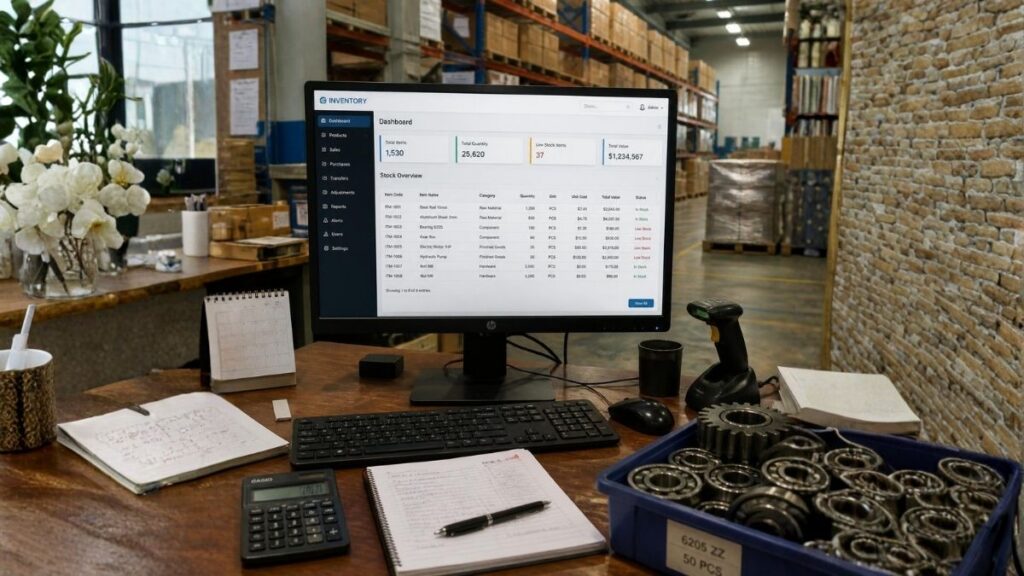
A genuine manufacturing inventory management system connects all four of these into one process. Software that only tracks SKUs and stock levels, without BOM-driven costing or MRP, is inventory software with a manufacturing label attached, not manufacturing software.
Cin7 Core and Business Central: Two Paths for Manufacturers
Every manufacturer evaluating a manufacturing inventory management system eventually faces the same fork: keep your accounting platform and connect a specialist inventory system to it, or run manufacturing and accounting natively inside one ERP. Cin7 Core and Microsoft Dynamics 365 Business Central represent the strongest options on each side of that fork, which is why they come up more than any other platform in conversations with Australian manufacturers.
Cin7 Core is inventory and omnichannel order management software built to sit alongside Xero, MYOB, or QuickBooks Online rather than replace them. Its Advanced Manufacturing module supports multi-level bills of materials with full traceability from concept to completion, letting you navigate nested production processes and build customisable BOMs across your manufacturing operation. Its Material Requirements Planning engine can explode a production BOM down through nested sub-assemblies to calculate real component demand, then schedule around available production capacity.
The module also handles parallel and non-parallel operation sequences, co-manufacturing, and virtual intermediate products for businesses running multi-stage production. For a manufacturer already committed to Xero or MYOB and not looking to migrate the ledger, Cin7 Core is usually the fastest way to get genuine BOM depth without a full ERP project.
Microsoft Dynamics 365 Business Central takes the opposite approach: manufacturing and finance live in one native system from day one. Its Premium tier unlocks the full Manufacturing module, including multi-level BOMs, routings, machine and work centres, capacity and load planning, and integrated Material Requirements Planning and Master Production Scheduling. Production orders in Business Central move through simulated, planned, firm planned, released and finished stages, bringing together BOMs, routings, resources, and capacity into a single operational record rather than a set of disconnected documents.
Essentials and Premium share the same core financial, sales, purchasing, and inventory foundation, with Premium adding the manufacturing and service order management that a genuine production business needs. For manufacturers who want one ledger, one login, and manufacturing built in rather than bolted on, Business Central is the more scalable long-term platform, particularly once you are managing multiple work centres or complex routings.
Neither platform is universally “better.” Cin7 Core wins on speed to value and lower implementation overhead for manufacturers who like their current accounting system. Business Central wins on depth of native manufacturing control and long-term scalability for manufacturers who expect to outgrow a bolt-on inventory system within a few years. VNC Australia works with both, which is why we tend to start every manufacturing engagement by establishing which of these two paths actually fits, rather than assuming.
How the Full Field of Platforms Compares
The technical checklist matters, but the relationship layer is where most payroll and bookkeeping services actually succeed or fail day to day. A provider can tick every compliance box and still leave you in the dark.
| Platform | Origin | BOM Depth | MRP / Production Planning | Best Fit | AU Accounting Integration |
|---|---|---|---|---|---|
| Cin7 Core | New Zealand, strong AU/NZ presence | Multi-level, with co-manufacturing and parallel operations | Yes, with BOM explosion for nested components | Manufacturers keeping Xero, MYOB or QuickBooks and adding manufacturing depth | Xero, MYOB, QuickBooks Online |
| Microsoft Dynamics 365 Business Central | USA (Microsoft) | Multi-level BOM, routings, machine and work centres (Premium) | Yes, full MRP and Master Production Scheduling | Manufacturers wanting accounting and manufacturing natively in one system | Native Business Central ledger |
| Unleashed | New Zealand | Multi-level BOM with subassembly tracking | Demand planning and rolling stocktakes | AU/NZ manufacturers wanting strong inventory accuracy without full ERP complexity | Xero, MYOB, QuickBooks Online |
| Katana Cloud Manufacturing | Estonia (global) | Multi-level, visual drag-and-drop scheduling | Yes, with a dedicated shop-floor app | Small manufacturers wanting a highly visual production view | Xero, QuickBooks Online |
| MRPeasy | Estonia (global) | Multi-level BOM with quality control workflows | Yes, production planning and scheduling built in | Small manufacturers needing purchasing, CRM and production in one system | Xero, QuickBooks |
| NetSuite | USA (Oracle) | Full multi-level BOM as part of a complete ERP | Yes, multi-currency, multi-entity planning | Larger manufacturers ready for a full ERP, not just inventory software | Native NetSuite ledger, or third-party connectors |
| Odoo Manufacturing | Belgium (global) | Multi-level BOM, modular by design | Yes, as part of the wider Odoo suite | Businesses adding manufacturing to an existing Odoo stack | Third-party connectors |
Where the Other Platforms Fit
Cin7 Core and Business Central cover most mid-market manufacturers, but the remaining platforms each solve a narrower, specific problem worth knowing about.
Unleashed leans into inventory accuracy over production scheduling. It supports rolling stock takes, automated purchase orders, and detailed bills of materials in one platform, with advanced demand planning to anticipate busy periods and avoid stockouts. If your main pain is stock accuracy rather than complex shop-floor scheduling, it is a lighter starting point than a full MRP system.
Katana is built around a visual, drag-and-drop production schedule. It automatically allocates raw materials to prioritised manufacturing orders and includes a dedicated shop-floor app for live production updates. Some reviewers have flagged reliability issues and a pricing model that has changed more than once, so test it against your own data volumes before committing.
NetSuite steps fully into enterprise ERP territory. It connects manufacturing directly with financials, supply chain, quality management, and CRM on one unified platform built for scale and complexity, making it a strong option once a business has genuinely outgrown mid-market tools, but rarely the right first step for a $10 million manufacturer.
Odoo rewards businesses wanting to start small. You can begin with core inventory features and progressively add manufacturing, CRM, point of sale, and accounting modules as the business scales, which suits manufacturers not yet ready to commit to a full ERP contract.
The Integration Question That Decides Everything Else
Choosing between manufacturing inventory management system options is really a decision about where your financial truth lives. This is the question most comparison guides skip, and it is usually the one that causes pain twelve months after go-live, not before it.

If your inventory platform shows one landed cost, and Xero or MYOB shows another, someone is reconciling two versions of the truth every month, usually by hand, usually late. Cin7 Core, Unleashed, Katana, and MRPeasy suit manufacturers who want to keep their existing accounting platform. Business Central and NetSuite suit manufacturers ready to run everything through one native ledger. Neither approach is wrong. The mistake is choosing an inventory management system for manufacturing before deciding which of those two paths you are actually on.
Australia’s manufacturing sector grew across all key measures in the 2024-25 financial year, with earnings rising 1.6 percent, largely on the back of a 7.8 percent gain in food product manufacturing. Growth like this is exactly when the gap between a manufacturer’s inventory system and accounting system starts to show, because rising volume punishes manual reconciliation faster than a flat year does.
Final Thoughts
There is no universal best inventory management system for manufacturing, only the right system for your BOM complexity, your production stages, and how committed you are to your current accounting platform. For most Australian manufacturers we work with, the decision comes down to Cin7 Core or Business Central: the former for speed and a lighter footprint alongside Xero or MYOB, the latter for manufacturers ready to run finance and production natively in one system. Unleashed, Katana, and MRPeasy solve narrower versions of the same problem, and NetSuite or Odoo make sense once your requirements genuinely outgrow mid-market tools.
The platform you choose matters less than the discipline of keeping your inventory numbers and your accounting numbers reconciled once it is live. That is where most manufacturers actually lose trust in their own numbers, long after the implementation project has finished.
VNC Australia works with manufacturers across Australia to implement and connect both Cin7 Core and Microsoft Dynamics 365 Business Central, so your BOMs, production costs and finished goods values match your books every month, not just at stocktake. Our manufacturing bookkeeping services cover BOM accuracy, WIP accounting and production costing, our Cin7 integration services handle setup and ongoing reconciliation, and our inventory accounting software guide for Australian manufacturers goes deeper on the Business Central Premium build for manufacturers ready for a native ERP.
Schedule a complimentary 30-minute consultation with the VNC Australia team: Book your call.
Frequently Asked Questions
For most Australian distributors and manufacturers between $5M and $50M in revenue, Microsoft Business Central is the strongest starting point, especially if the business already runs on Microsoft 365. Retail-heavy businesses with lighter accounting needs sometimes start with an inventory platform like Cin7 instead and move to full ERP software once financial complexity grows.
For most manufacturers in the USD $5 million to $30 million range, Cin7 Core and Microsoft Dynamics 365 Business Central are the two strongest starting points. Cin7 Core suits businesses keeping Xero or MYOB as their ledger; Business Central suits those wanting manufacturing and accounting natively in one system.
Cin7 Core is inventory management and omnichannel order management software with manufacturing and MRP capabilities. It is not an ERP in the traditional sense (like NetSuite or SAP), and it is designed to integrate with your existing accounting platform rather than replace it.
The Premium tier of Business Central includes the full Manufacturing module natively, covering multi-level BOMs, routings, machine and work centres, capacity planning, and MRP. The Essentials tier only includes basic assembly management, not full production planning.
BOM tracking tells you what a product should be made from. MRP tells you when to order those materials based on actual demand. If you are still deciding to reorder timing manually, an inventory management system for manufacturing without MRP will not solve that for you.
Most platforms calculate GST on purchases and sales automatically once connected to Xero, MYOB, or QuickBooks Online, or natively in Business Central, but landed costs (freight, duty, insurance) need to be mapped correctly to avoid distorting your BAS figures. This is one of the most common setup errors we see in manufacturer accounts.
For manufacturers wary of a large ERP investment, Cin7 Core, Unleashed and MRPeasy offer manufacturing-grade features without the implementation scope of NetSuite or Business Central Premium. Pricing on all platforms changes fairly often, so confirm current tiers directly with each vendor before deciding.
Cin7 Core, Katana and Unleashed can go live in a matter of weeks for straightforward BOMs. Business Central Premium and NetSuite implementations are measured in months once data migration, routing setup and staff training are factored in.