


Table of Contents
ToggleA warehouse stock management system is the difference between knowing exactly what’s on your shelves and finding out the hard way when a customer orders 200 units you don’t actually have. For a distributor or manufacturer moving past the $5 million mark, that gap stops being a minor annoyance. It starts showing up in your bank balance.
Most growing businesses in Australia don’t outgrow their warehouse. They outgrow the spreadsheet, the whiteboard, or the “someone will remember” system that used to work when there were 200 SKUs instead of 2,000. The warehouse itself is fine. What’s broken is the visibility.

This guide walks through what a real warehouse stock management system does, how stock management and stock forecasting work inside Cin7 specifically, and the mistakes we see most often when Australian businesses try to fix this themselves.
Why Warehouse Stock Management Matters for Growing Australian Businesses
Inventory is usually the largest working asset on a distributor’s balance sheet, and it’s also the easiest one to lose track of. According to the Australian Bureau of Statistics, wholesale trade inventories rose 1.0% in the March 2026 quarter, part of a broader pattern of businesses rebuilding stock levels after a soft patch through late 2025. That kind of swing matters. Every dollar sitting in stock is a dollar not available for payroll, marketing, or growth.

Under AASB 102, Australia’s accounting standard for inventories, stock has to be measured at the lower of cost or net realisable value. The standard exists precisely because the amount of cost carried forward as an asset determines when it hits your profit and loss as an expense. In plain terms: if your stock counts are wrong, your cost of goods sold is wrong, and your reported profit is wrong too. This isn’t an accounting technicality. It’s the reason two businesses with identical sales can report completely different margins.
Growth makes all of this worse before it makes it better. More SKUs, more warehouse locations, more sales channels, and more people touching stock all multiply the number of places where a manual system can quietly fall apart.
Signs You've Outgrown Your Current Stock System
Most businesses don’t decide to switch systems. They get forced into it after enough small failures pile up. Watch for these six signs.
- Stocktakes take days instead of hours, and the count still doesn’t match what’s in the system afterwards.
- You’re overselling or underselling the same SKU across two or more channels because nothing updates in real time.
- Reordering is based on memory or gut feel rather than actual sales velocity and lead times.
- Nobody can tell you which products are actually profitable once freight, duty, and warehousing costs are factored in.
- Month-end close depends on someone manually reconciling a spreadsheet against what the warehouse physically holds.
- Adding a new sales channel or warehouse location feels like a project, not a five-minute setup change.
If two or more of these sound familiar, the fix usually isn’t more effort from your team. It’s a system built to handle the volume you’re at now, not the volume you had two years ago.
What a Warehouse Stock Management System Actually Does
A warehouse stock management system tracks every unit of stock, from the moment it arrives at your dock to the moment it leaves as a sale, and keeps that number synced with your accounting platform in real time. It replaces the spreadsheet, the physical stocktake guesswork, and the “I think we have some left” conversation.
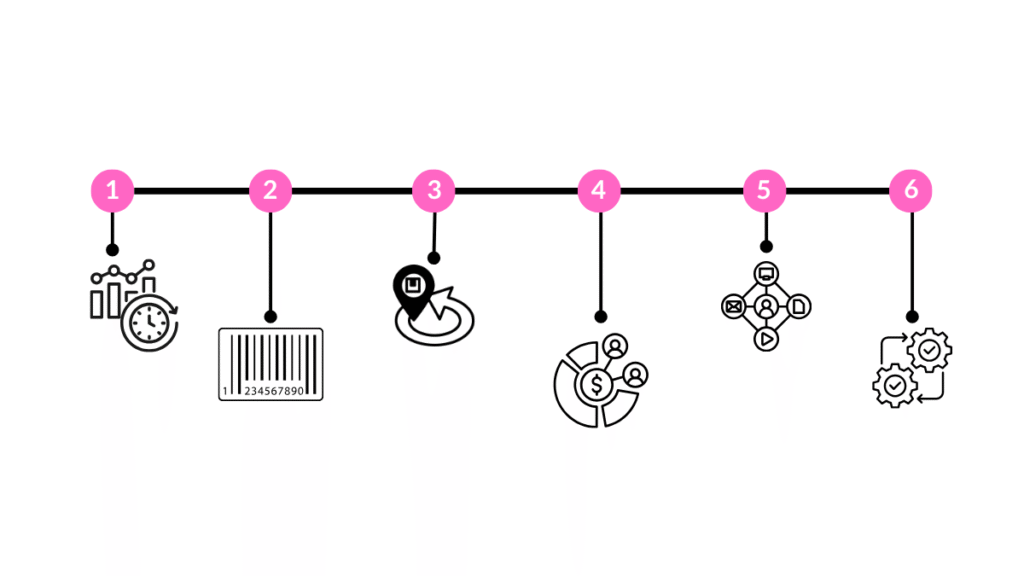
At a practical level, a proper system handles six things:
- Real-time stock levels across every warehouse, van, or 3PL location you use
- Barcode or SKU-level tracking so every movement is logged, not estimated
- Automated reorder points that flag or trigger purchase orders before you run out
- Landed cost allocation, spreading freight, duty, and insurance across the units that actually incurred them
- Multi-channel sync across Shopify, Amazon, B2B, and in-store so you never oversell the same unit twice
- Integration with Xero, MYOB, or QuickBooks Online so your inventory ledger and your accounting ledger tell the same story
Warehouse stock management isn’t just about knowing quantities. It’s about knowing which of those quantities are actually profitable to hold, and which are quietly tying up cash you could be using elsewhere.
How to Choose the Right Warehouse Stock Management System
The right system for a $6 million business often looks different from the right system for a $25 million one, so the honest answer is to match the tool to where you’re headed, not just where you are today. A few factors matter more than the rest.

Stock Management and Stock Forecasting on Cin7
Cin7 is the platform we see most often among Australian and New Zealand product businesses, and for good reason. Stock management on Cin7 gives you a single live view of inventory across every location, sales channel, and supplier, rather than the fragmented picture most businesses piece together from three separate systems.
The forecasting side is where the real value shows up. Stock forecasting on Cin7 works off your actual sales history rather than a gut feeling. Cin7’s inventory velocity reporting forecasts future product sales from your existing sales history and generates suggestions for when to replenish stock, factoring in supplier lead times so reorders happen before you run dry, not after.
For businesses managing more SKUs, Cin7’s ForesightAI module goes further. It draws on up to two years of sales history, runs it through roughly 100 forecasting algorithms, and averages the outputs into a single SKU-level forecast. It flags winners, losers, and rising products automatically and calculates optimal reorder points without a spreadsheet in sight.
The catch is that Cin7 is only as good as the accounting and process setup behind it. We regularly see businesses with Cin7 correctly tracking stock movements while their Xero file still shows a different number, because nobody reconciled the two systems after go-live. Stock management on Cin7 solves the operational side. It doesn’t automatically solve the accounting side, and that’s where a lot of growing businesses get caught out.
Common Mistakes and How to Avoid Them
Most of the damage doesn’t come from choosing the wrong software. It comes from how the system is set up and maintained after go-live. Here are the five mistakes we see most often.

Reorder points, supplier lead times, and BOM structures all drift as your business changes. A system configured for $8 million in revenue won’t behave correctly at $18 million unless someone revisits the settings.
Freight, customs duty, and insurance get lumped into a general expense account instead of being spread across the units they relate to. This inflates margins on paper and quietly erodes them in reality.
This is the single most common issue we see. Your warehouse stock management system shows one number, Xero shows another, and nobody notices until a stocktake or an audit forces the question.
A system that tracks quantity but not velocity will happily let dead stock sit on the shelf for months. Cash trapped in inventory that isn’t moving is one of the most common reasons profitable-looking businesses run short on cash.
Many Cin7 users never move past manual reorder lists, even though stock forecasting on Cin7 is built into the platform they’re already subscribed to.
Final Thoughts
A warehouse stock management system isn’t a nice-to-have once you cross the $5 million mark. It’s the infrastructure that lets you scale without guessing and without discovering your real margins three weeks after month-end close. Getting the software right matters. Getting the accounting behind it right matters just as much, and it’s the part most businesses overlook until it costs them.
Ready to get your warehouse stock management sorted? VNC Australia works exclusively with manufacturers and distributors across Australia and New Zealand, and we handle the accounting, the Cin7 integration, and the inventory forecasting in between, so you stop guessing and start knowing.
When inventory, purchasing, production, and accounting all work from the same set of numbers, month-end becomes faster, reporting becomes more reliable, and decision-making becomes much simpler. VNC Australia helps manufacturers, wholesalers, and distributors implement Microsoft Business Central in a way that connects finance and operations without adding unnecessary complexity.
Schedule a complimentary 30-minute consultation with the VNC Australia team: Book your call.
Frequently Asked Questions
A warehouse stock management system is software that tracks inventory quantities, locations, and movements in real time, and syncs that data with your accounting platform. It replaces manual stocktakes and spreadsheets with a live, single source of truth for what you actually have on hand.
Warehouse stock management focuses on quantities, reorder points, and cost tracking, while a full WMS also covers physical warehouse operations like pick paths, bin locations, and labour. Growing distributors usually need strong stock management first, and layer in WMS features as pick-and-pack volume increases.
Yes. Cin7’s forecasting tools use historical sales data and supplier lead times to suggest reorder timing and quantities automatically, rather than relying on someone noticing stock is low. Businesses using AI-driven forecasting through Cin7’s ForesightAI have reported lower stockout rates alongside reduced excess stock.
Cin7 is the platform we work with most often for AU and NZ manufacturers and distributors because of its depth of integration with Xero, MYOB, and multi-channel sales platforms. Other tools can work, but the accounting integration and forecasting depth are usually the deciding factors for businesses over $5 million in revenue.
AASB 102 requires inventory to be measured at the lower of cost or net realisable value, which means write-downs are required when stock is worth less than what you paid for it. Getting this wrong overstates your assets and your reported profit, which becomes a real problem at tax time or when a bank asks for financials.
It varies by industry, but ABS data shows wholesale trade inventories move by roughly 1% or more per quarter on a national scale, which reflects how much capital sits in stock at any given time across the sector. At a business level, slow-moving SKUs that nobody reviews regularly are one of the most common places we find trapped cash during a VNC review.
Start with a reconciliation between your inventory system and your accounting ledger, because that’s usually where the real number problems live, not in the warehouse itself. From there, review reorder points and forecasting settings, since these tend to drift as the business grows and rarely get revisited.