



Table of Contents
ToggleHoliday inventory forecasting usually gets decided in a hurry. A supplier wants confirmed quantities by Friday, the sales team is quoting last December from memory, and the buyer is working from a spreadsheet that doesn’t quite match what Cin7 Core or Xero says is on hand. The purchase order goes in anyway, because the container has to leave on time.
Six weeks later, the results show up in two places. The three products customers wanted most are gone by the second week of December, while the warehouse is still full of lines that looked like safe bets in October. Both problems came from the same holiday inventory forecasting call, made in a rush in October.
For product businesses, that combination hurts twice. Lost sales disappear quietly, and slow stock sits on the balance sheet, holding cash you needed in January. The good news is that holiday inventory forecasting works with data you already have, as long as you bring clean history, a clear method and a calendar that starts early enough. The five steps below show how wholesalers, distributors, retailers and manufacturers can build a forecast that holds up when demand spikes.
Why Holiday Inventory Forecasting Gets Harder Every Year
The Australian peak season has grown longer and busier, which makes holiday inventory forecasting less forgiving. Demand now builds through November, peaks before Christmas and returns for Boxing Day, so a forecast built around December alone misses the first wave.
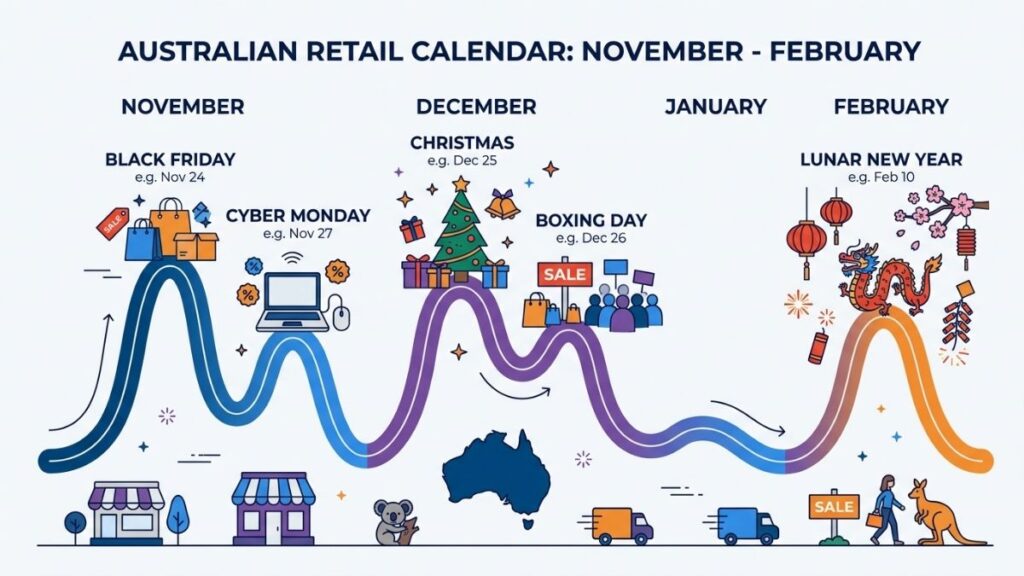
The latest figures show how big that window has become, and why holiday inventory forecasting now has to start well before December:
- Black Friday Lift: The ABS reported that household spending rose 1.0% in November 2025, with goods spending up 0.9% on the back of Black Friday sales. Furnishings and household equipment led the categories with a 2.2% rise.
- Six Weeks of Peak Trading: The Australian Retailers Association and Roy Morgan forecast $72.4 billion in retail spending for the six weeks from 13 November to Christmas Eve 2025, up 4% on 2024. The same survey found 29% of shoppers were buying gifts earlier than the year before.
- The Post-Christmas Wave: Roy Morgan’s Boxing Day forecast put the day alone at around $1.6 billion in 2025, with the full week from 25 to 31 December at $3.832 billion.
The cost of getting it wrong is well documented. IHL Group’s 2025 research on inventory distortion estimates that retailers worldwide lose 6.5% of sales to out-of-stocks and overstocks combined. For discretionary retailers, the ARA has said peak season can deliver up to two-thirds of annual profits, so a holiday inventory forecasting miss is hard to recover from.
Here are the dates that matter for this year’s holiday inventory forecasting:
| Event | 2026 to 2027 Date | What It Means for Stock |
|---|---|---|
| Black Friday | Friday 27 November 2026 | Promotional demand often starts weeks earlier. |
| Cyber Monday | Monday 30 November 2026 | Online promotions continue and pick capacity tightens. |
| Christmas Day | Friday 25 December 2026 | Last practical delivery cut-offs fall in the week before. |
| Boxing Day | Saturday 26 December 2026 | Clearance window for excess stock. |
| Lunar New Year | Saturday 6 February 2027 | Supplier slowdowns can delay January replenishment. |
Step 1: Clean the Sales History Before You Trust It
Holiday inventory forecasting starts with history, and holiday history is usually the messiest data in the system. Before you calculate anything, spend an afternoon making sure last year’s numbers describe real demand.
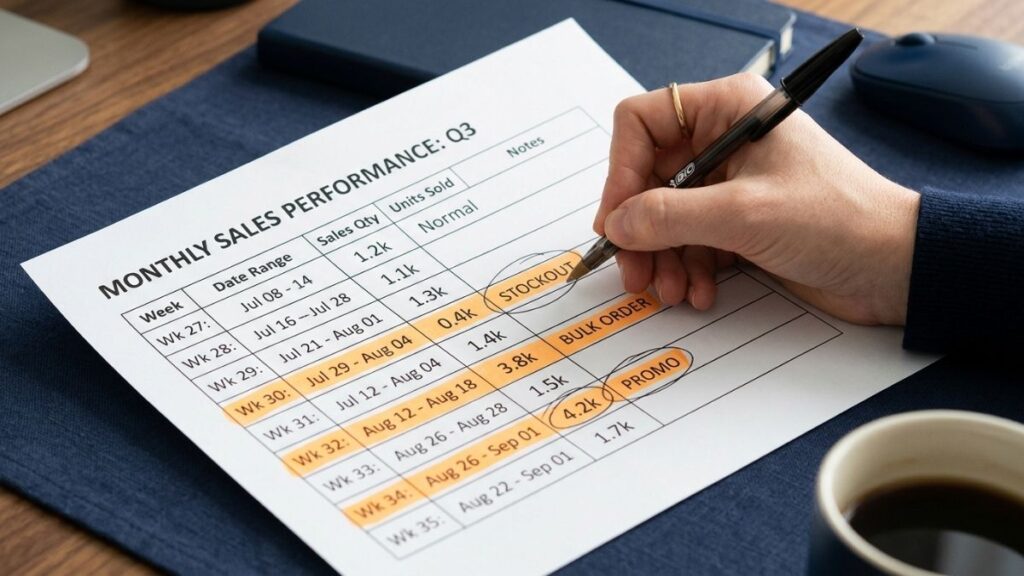
These are the distortions worth fixing first:
- Stockout Weeks: Sales for an item that sold out only record the stock you had available. Customers who arrived after that point never appear in the report, so flag any week with zero stock and estimate the missed demand from the weeks around it.
- One-Off Bulk Orders: A single large wholesale order or tender can inflate a SKU’s history. Separate it so it doesn’t become next year’s baseline.
- Promotion Weeks: Tag every promotional week. You need to know whether a spike came from the season or from a 30% discount.
- Returns and Cancellations: January returns can make December look stronger than it was. Net them off before you measure the seasonal lift.
- System Mismatches: If Cin7 Core, Xero and the warehouse count disagree, your forecast inherits the error. Reconcile them before you forecast, and a well-built Cin7 Xero integration keeps them aligned once fixed.
Seasonal demand forecasting built on distorted history will repeat last year’s mistakes with more confidence.
Step 2: Separate Baseline Demand From the Holiday Lift
Good holiday inventory forecasting separates two things: what a product sells in a normal week and how much the season multiplies that. Seasonal demand forecasting works best when you measure those separately, because baseline demand changes year to year while the seasonal pattern tends to repeat.
The simplest reliable method is a seasonal index:
- Find the Baseline: Calculate average weekly sales in quiet months, such as September and October last year.
- Measure the Lift: Divide average weekly sales in each peak period by that baseline. The result is your seasonal index.
- Update the Baseline: Calculate this year’s September and October average.
- Apply the Index: Multiply this year’s baseline by last year’s index for each peak period.
Here is a worked example for one SKU. The figures are illustrative only.
| Period | Last Year Avg Weekly Units | Seasonal Index | This Year Baseline | Forecast Avg Weekly Units |
|---|---|---|---|---|
| Sept to Oct (baseline) | 100 | 1.0 | 110 | 110 |
| November | 180 | 1.8 | 110 | 198 |
| 1 to 24 December | 240 | 2.4 | 110 | 264 |
If this SKU sold out in mid-December last year, the 2.4 index understates true demand, and your holiday inventory forecasting will under-order again. That is why Step 1 comes first. Holiday demand forecasting at SKU level also works better when you group slow movers by category, since a product that sells three units a week will give you a noisy index on its own.
Step 3: Work Backwards From Supplier Lead Times
Holiday inventory forecasting is only useful if the stock can physically arrive in time. Seasonal inventory planning means taking each forecast and turning it into a latest-possible order date for every supplier.
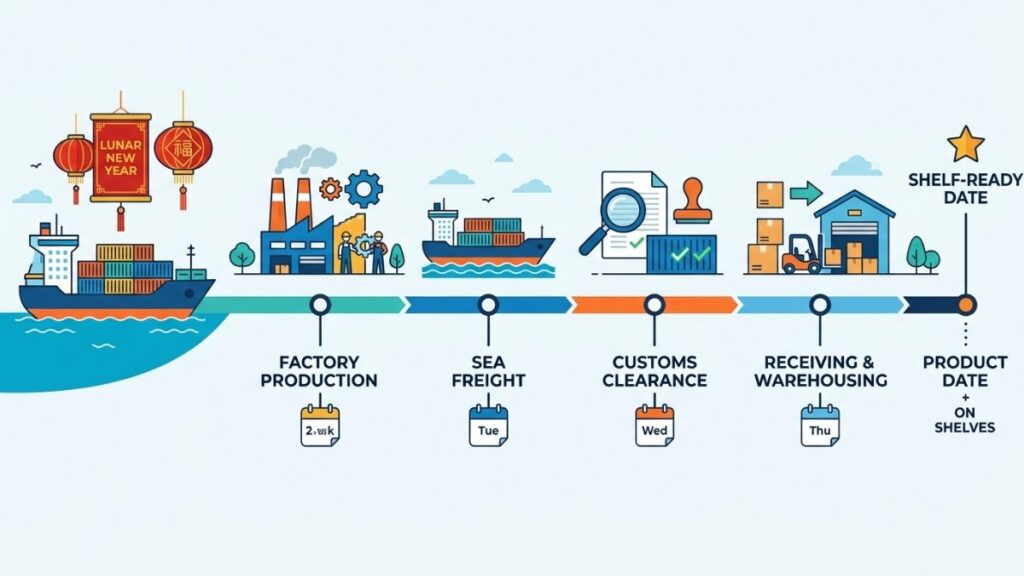
Start with the date stock must be shelf-ready, then subtract:
- Production Time: How long your supplier needs to make or pick the order during their own busy season.
- Freight and Customs: Sea freight, port handling and clearance, using your recent actuals rather than quoted times.
- Receiving and Put-Away: The days your warehouse or 3PL (third-party logistics provider) needs to receive, check and shelve stock.
Once stock is ordered, the reorder point keeps fast sellers topped up through the peak. A common formula is average daily demand multiplied by lead time, plus safety stock. Safety stock is the buffer that covers demand above forecast or a late shipment.
Don’t forget the other side of the season. Lunar New Year falls on 6 February 2027, and many suppliers in China slow down or close for a period around it. If your January restock depends on those suppliers, your seasonal inventory planning should place those orders before Christmas. In practice, holiday inventory forecasting for importers needs to run through to February.
Step 4: Set Holiday Stock Levels by SKU Priority
Treating every product the same is one of the quickest ways for holiday inventory forecasting to produce stockouts and overstock at once. Stock level forecasting works better when each SKU gets a buffer that matches its value to the business.
An ABC split based on gross margin and sales frequency is a practical starting point:
| SKU Group | Typical Profile | Holiday Approach |
|---|---|---|
| A Items | Top sellers are driving the most gross profit. | Order first, hold higher safety stock, review weekly. |
| B Items | Steady sellers with moderate margins | Standard safety stock, reviewed fortnightly |
| C Items | Slow or low-margin lines | Minimal buffer, avoid holiday-only buys. |
| New or Untested | No reliable history | Small first order with a confirmed reorder option |
For multi-location businesses, run stock level forecasting by warehouse or store as part of your holiday inventory forecasting. A national total can look healthy while one state runs dry. Holiday demand forecasting by location also helps you decide whether to transfer stock or reorder, which matters when freight capacity is tight in December.
Step 5: Plan the Exit Before the Peak Starts
Overstock decisions are far cheaper in October than in January, so holiday inventory forecasting should cover the way out as well as the way in. Holiday demand planning should include a clear plan for what happens to stock that doesn’t sell, agreed before the first order is placed.

Build these exit rules into the plan now:
- Weeks-of-Cover Triggers: Set a point, such as more than eight weeks of cover in mid-December, that automatically starts a markdown or bundle conversation.
- Boxing Day Allocation: Decide which lines are earmarked for post-Christmas clearance and price them before the rush.
- Supplier Terms: Check return, cancellation and split-delivery terms while you still have negotiating room.
- Year-End Valuation: Seasonal stock still on hand at 30 June gets counted. The ATO’s guidance on valuing trading stock requires a stocktake as close as possible to the end of the income year, valued at cost, market selling value or replacement value.
Unsold holiday stock is also a cash flow issue. Every dollar sitting in slow lines is a dollar unavailable for the next buy, which is why working capital planning belongs in the same conversation as holiday inventory forecasting.
How Cin7 Demand Forecasting Supports Holiday Demand Planning
Spreadsheets can handle holiday inventory forecasting for a few dozen SKUs. Once you’re managing hundreds of products across channels and locations, Cin7 demand forecasting takes much of the manual effort out of holiday demand planning.

Cin7 says basic forecasting and planning features are included in every package, while its AI-driven tool, ForesightAI, is a paid add-on. According to Cin7’s help documentation, ForesightAI works like this:
- Data Requirement: It needs at least six months of sales history in Cin7 Core.
- Daily Updates: Forecasts are recalculated once a day, and inventory changes can take up to 24 hours to appear.
- Smart Reorder: Purchase suggestions combine demand forecasts, purchase order periods, lead times and buffer stock.
- Manual Adjustments: You can override forecasts for planned promotions or a seasonal spike you know is coming.
One caution applies to any holiday inventory forecasting tool. Cin7 demand forecasting learns from your history, so last year’s stockouts and data errors flow straight into this year’s suggestions unless you correct them. The tool also works best when Cin7 Core and Xero agree on stock value, because purchase suggestions quickly become cash commitments.
Your Holiday Inventory Forecasting Checklist for the Next Six Weeks
If Black Friday is about six weeks away, there is still time to tighten the plan. Use this checklist to keep holiday inventory forecasting on track:Spreadsheets can handle holiday inventory forecasting for a few dozen SKUs. Once you’re managing hundreds of products across channels and locations, Cin7 demand forecasting takes much of the manual effort out of holiday demand planning.
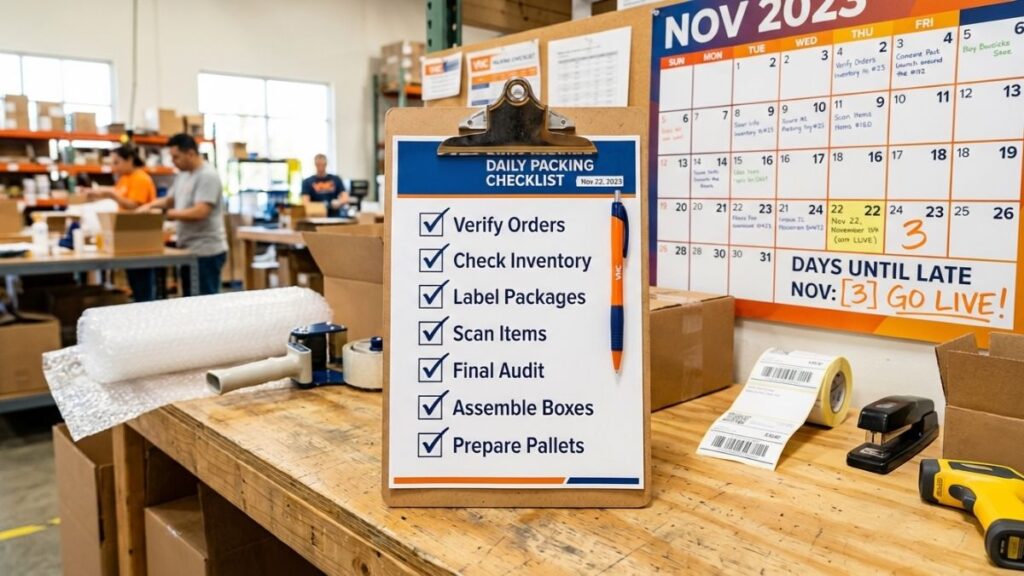
If Black Friday is about six weeks away, there is still time to tighten the plan. Use this checklist to keep holiday inventory forecasting on track:
- Reconcile First: Match Cin7 Core, Xero and the latest stock count for your top 50 SKUs.
- Flag Stockout Weeks: Mark last year’s zero-stock weeks and estimate the demand you missed.
- Calculate Seasonal Indexes: Build November and December indexes for A and B items.
- Confirm Lead Times: Ask suppliers for current peak-season lead times in writing.
- Set Order Deadlines: Work backwards from shelf-ready dates for every supplier.
- Agree Exit Rules: Set weeks-of-cover triggers and Boxing Day allocations.
- Book a January Review: Compare forecast against actual sales by SKU while the data is fresh.
The January review is where seasonal inventory forecasting improves year after year, because it turns this year’s holiday inventory forecasting into next year’s starting point.
Final Thoughts
Holiday inventory forecasting works when it is treated as a finance process as much as a buying decision. The businesses that handle peak season well tend to do the same few things: they clean their history, separate baseline from seasonal lift, respect lead times, protect their best SKUs and decide what happens to leftovers before the season starts. Each step is straightforward, and each one depends on numbers you can trust.
That is where most mid-market product businesses get stuck. Inventory sits in one system, the accounts sit in another, and the forecast lives in a spreadsheet that nobody fully trusts. Seasonal inventory forecasting gets much easier once those pieces agree, because every decision about what to buy is also a decision about cash. Holiday inventory forecasting is one of the clearest places to see that link. Connecting inventory, accounting, analysis and automation is exactly where VNC focuses as a finance partner to product-based businesses across Australia, New Zealand, the USA, the UK and Switzerland.
VNC works with manufacturers, wholesalers, distributors and retailers to connect Cin7 Core, Xero and the reporting in between, from Cin7 integration to inventory forecasting and month-end reporting. If holiday inventory forecasting still runs on spreadsheets in your business, take the free Cin7 scorecard, a 15-minute self-assessment built with tips from the Best Cin7 Core Experts. You’ll get a readiness score, a breakdown by area and your top priorities before the busiest weeks of the year.
Schedule a complimentary 30-minute consultation with the VNC team: Book your call.
Frequently Asked Questions
Holiday inventory forecasting is the process of estimating how much of each product you will sell during peak periods such as Black Friday, Christmas and Boxing Day, then planning purchases so stock arrives in time. It combines your normal baseline demand with a seasonal lift measured from previous years.
Start holiday inventory forecasting early enough to cover your longest supplier lead time plus receiving time. For businesses importing by sea, that often means finalising quantities by August or September. If you’re already in October, focus on fast-moving A items and confirmed local suppliers.
Yes. Cin7 says basic forecasting is included in every package, and its ForesightAI add-on provides AI-driven forecasts and Smart Reorder suggestions. ForesightAI needs at least six months of sales history in Cin7 Core and lets you manually adjust forecasts for planned promotions.
Good holiday inventory forecasting prioritises SKUs by margin and sales frequency, holds higher safety stock only on the best sellers and sets weeks-of-cover triggers for markdowns. Correcting last year’s stockout weeks before calculating seasonal indexes also stops you from under-ordering the products that sold out.
Stock still on hand at 30 June is included in your end-of-year stocktake. The ATO allows trading stock to be valued at cost, market selling value or replacement value, and you can choose a different method for different items each year. Speak with your adviser before choosing a method.
Get help when Cin7 Core, Xero and your warehouse counts don’t match, when forecasting lives in spreadsheets only one person understands, or when last year’s peak ended with both stockouts and excess stock. Those are signs that holiday inventory forecasting needs better data and a better process behind it before any new forecast will help.