



Table of Contents
ToggleA Cyber Monday sale gives you roughly 24 hours to sell stock that took months to buy, and almost every decision about how much you’ll have is made before the day arrives.
Black Friday goes better than expected, your best seller is down to its last few dozen units, and Cin7 Core is flagging it for reorder. Your supplier won’t pick up the phone until Monday, the freight won’t move until Tuesday, and by then the Cyber Monday sale is over. Whatever sits on the shelf at 6am on Monday is all you get to sell.

That makes this year’s Cyber Monday sale worth planning properly. Roy Morgan and the Australian Retail Council expect Australians to spend a record $7.2 billion across the four days from 27 to 30 November 2026, and the average shopper plans to spend $920, up 14.4% on last year. Last year, Australia Post saw $1.5 billion online over the Black Friday and Cyber Monday weekend, with 3.1 million households placing orders.
So how do you forecast stock levels for a Cyber Monday sale? This guide walks wholesalers, distributors, retailers, and manufacturers through it one SKU at a time, using the sales history already sitting in Cin7 Core and Xero.
Why a Cyber Monday Sale Needs Its Own Forecast
A Cyber Monday sale works differently from Black Friday, so it deserves its own line in your plan. These four reasons explain why.
- It Follows a Weekend You Can’t Restock: Suppliers and carriers often run reduced hours over Saturday and Sunday, so Monday’s stock is whatever survives Black Friday. Your Cyber Monday sale forecast has to start from that number.
- It Leans Heavily Online: In the US, Adobe recorded $14.25 billion in online spending on Cyber Monday 2025, a new record. Some categories jumped far more than others, with Bluetooth headphone and speaker sales up 1,850% on average October levels.
- Category Swings Are Large: Australia Post reported growth of 42% in athleisure, 24.7% in books and stationery and 18% in women’s fashion during last year’s sale weekend. An average uplift across your range will hide big differences between SKUs.
- Shoppers Are Buying Ahead: The latest ARC and Roy Morgan research found 39% of shoppers plan to use the sales to save on Christmas gifts, up from 25% last year. Units sold in a Cyber Monday sale may be units you would otherwise have sold in mid-December.
That last point matters for inventory forecasting beyond the sale itself. A strong Cyber Monday sale can pull demand out of the weeks that follow, so orders copied from last year’s pattern may be too high.
Here’s how the days around the sale shape what you can still change:
| Date | What’s Happening | What You Can Still Change |
|---|---|---|
| Tue 24 to Thu 26 November | Last normal trading days | Local top-ups, transfers between locations and final allocations |
| Fri 27 November | Black Friday | Prices, ad spend and how much each channel can sell |
| Sat 28 to Sun 29 November | Weekend trading | Very little stock movement, so review results and re-forecast |
| Mon 30 November | Cyber Monday | Which SKUs to promote, pause or swap |
| Mon 21 December | Australia Post Parcel Post cut-off for most interstate metro deliveries | The last practical date to restock and ship before Christmas |
| Wed 23 December | Express Post cut-off for most metro deliveries | Final urgent shipments |
The December dates come from Australia Post’s Christmas cut-off dates, which are earlier for parcels to and from WA and the NT.
Stock Level Forecasting Starts With Monday Morning
The most useful number in your plan is the stock you’ll have when the Cyber Monday sale opens. Stock level forecasting for the sale means working that figure out now, for every SKU you intend to promote.
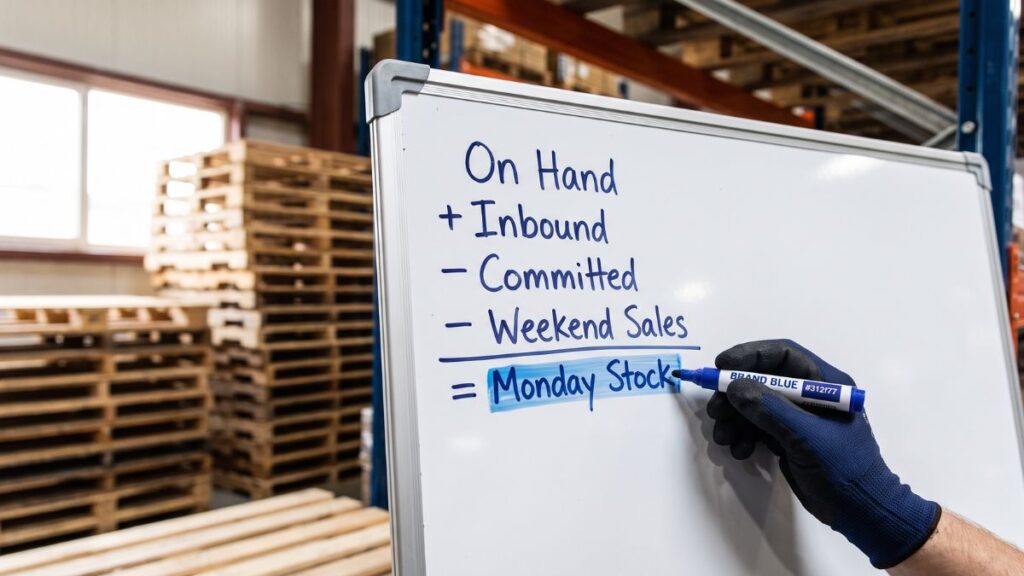
The calculation is simple. Take the stock available today, add confirmed deliveries arriving before Friday, subtract stock already promised to wholesale customers, then subtract your forecast sales from Black Friday to Sunday.
Each part needs a little care:
- Use Available Stock: Cin7 Core shows on-hand, allocated and available quantities. Available is the figure that matters, because allocated stock already belongs to an order.
- Count Only Confirmed Deliveries: A container that hasn’t cleared the port by Wednesday is a risk to your plan. Leave it out until it has been received.
- Forecast the Weekend First: Black Friday takes the first share of your stock, so your Cyber Monday sale forecast depends on getting Friday to Sunday roughly right.
Here’s a worked example for one best-selling SKU. The figures are illustrative only.
| Line | Units |
|---|---|
| Available in Cin7 Core today | 260 |
| Confirmed delivery arriving Wed 25 November | 80 |
| Less wholesale orders shipping this week | (40) |
| Stock available for the sale | 300 |
| Less forecast sales, Friday to Sunday (84 + 42 + 35) | (161) |
| Projected Monday opening stock | 139 |
If your Cyber Monday sale forecast for this SKU comes in above 139 units, you have three choices. You can reduce the offer, cap quantities per customer or plan for a sell-out and line up a backup product. Each is a sound decision on Thursday and a much harder one at 11am on Monday.
Estimating Cyber Monday Sale Demand SKU by SKU
Once you know what you’ll open with, the next job is estimating how much each SKU will sell during the Cyber Monday sale. Seasonal demand forecasting for a single day works best with a simple multiplier taken from your own sales history.

Work through these five steps for each promoted SKU:
- Find Your Baseline: Calculate average daily sales on normal, non-promotional days in October and early November this year.
- Measure Last Year’s Lift: Divide the SKU’s sales during last year’s Cyber Monday sale by its baseline at that time. The result is your event multiplier.
- Correct for Sell-Outs: If the SKU ran out partway through last year’s Cyber Monday sale, recorded sales understate real demand. Use your own hourly order pattern to estimate the full day.
- Adjust for What’s Changed: A different discount, a new sales channel, more ad spend or a stronger competitor offer will all move the number. Write the adjustment down along with the reason.
- Apply It: Multiply this year’s baseline by the corrected multiplier and your adjustment.
Here’s how that looks for the same SKU, again with illustrative figures:
| Input | Value |
|---|---|
| This year’s baseline | 14 units a day |
| Last year’s baseline | 12 units a day |
| Last year’s Cyber Monday sales | 50 units, sold out at 2pm |
| Share of a typical Cyber Monday’s orders placed by 2pm (your own data) | 60% |
| Estimated full-day demand last year | 83 units |
| Corrected event multiplier | 6.9 times baseline |
| Adjustment for a smaller discount this year | 0.9 |
| This year’s Cyber Monday forecast | 88 units |
Skip step three and the forecast comes out at about 53 units. You would plan for roughly 35 fewer sales than the day is likely to bring, and repeat last year’s sell-out with more confidence.
New products have no history to work from, so borrow the multiplier from a similar SKU in the same category and price range. For slow sellers, group them by category, because a product that sells two units a week gives a very noisy multiplier on its own. For the wider November to January picture, the guide to holiday inventory forecasting explains how to build seasonal indexes for the full peak.
If you’d prefer to skip the spreadsheet, the free SKU planning tool works out how many units to buy and the latest date to order each product.
Reorder Point Calculation When the Sale Moves Faster Than Your Supplier
A reorder point tells you when to place the next order. The standard reorder point calculation assumes demand stays fairly steady, and a Cyber Monday sale breaks that assumption for a day or two.
The usual formula is average daily demand multiplied by supplier lead time in days, plus safety stock. Safety stock is the buffer that covers demand above forecast or a late delivery.
For our SKU in a normal week, that works out to 14 units a day multiplied by a three-day local lead time, plus 10 units of safety stock, which gives a reorder point of 52. Leave that setting in place during the Cyber Monday sale and the alert fires on Monday afternoon with well under a day of stock left at sale pace, while the replacement takes three days to arrive.
The fix is to recalculate the reorder point using the demand you expect over the three days that start on Monday:
| Particular | Normal Week | Cyber Monday Week |
|---|---|---|
| Daily demand used | 14 units | 88, then 28, then 21 units |
| Supplier lead time | 3 days | 3 days |
| Lead time demand | 42 units | 137 units |
| Safety stock | 10 units | 20 units |
| Reorder point | 52 units | 157 units |
The adjusted reorder point of 157 is higher than the projected opening stock of 139. That means the top-up order for this SKU is already due before the Cyber Monday sale starts, and it should go to your local supplier on Thursday or Friday for delivery early the following week.
If you use Cin7 Core, three settings deserve a look before Friday:
- Minimum Before Reorder by Location: Cin7 Core lets you set a Minimum Before Reorder and a Reorder Quantity for each location, and a product moves to the reorder list once it reaches that level. Raise it for promoted SKUs at the location that ships your online orders.
- Sales History Suggestions: Cin7 Core uses your existing sales history to suggest replenishment orders. A normal October will understate a Cyber Monday sale, so check the suggestions for promoted lines by hand before you approve them.
- A Reset Date: Put the temporary levels back on 1 December. Higher thresholds left in place will keep producing purchase suggestions through December, and the Cyber Monday sale itself can lift average sales velocity in any report period that includes it.
Checking Your Forecast After the Cyber Monday Sale
Once the sale closes, compare what actually sold with what you forecast. Inventory forecasting gets more accurate each time you do this, and Tuesday morning is the best time while the numbers are fresh.Your first meeting tells you more than any website. A strong firm will ask you plenty of questions too, about your channels, systems and growth plans.

These four checks close the loop:
- Compare Forecast With Actual Sales: For each promoted SKU, record what you forecast, what sold during the Cyber Monday sale, and the time it sold out, if it did.
- Re-Forecast Sold-Out Lines Straight Away: If a hero SKU sold out, check whether a top-up can land in time to ship before Christmas. For most interstate metro Parcel Post, the last sending date is Monday 21 December 2026.
- Adjust Upcoming Orders for Early Buying: With more shoppers buying gifts in the sales, some SKUs may sell less in mid-December than last year’s pattern suggests. Compare each promoted SKU’s run rate in the first week of December with its baseline before placing more orders.
- Match Stock and Books: Reconcile Cin7 Core with Xero for every promoted SKU, including returns and cancellations. Reliable inventory accounting support at this point means the margin you report for the Cyber Monday sale is the margin you actually made.
Seasonal demand forecasting improves each year when this review is written down. Next November, the event multipliers and sell-out times you record this week become your starting point.
A Ten-Day Countdown to Your Cyber Monday Sale
With ten days to go, the remaining work is manageable if each task has an owner and a date. This Cyber Monday sale countdown suits a team using Cin7 Core and Xero, though the steps work with any inventory system.
| When | What to Do |
|---|---|
| Fri 20 to Mon 23 November | Pull baselines and last year’s event multipliers, flag last year’s sell-outs and confirm every SKU in the sale. |
| Tue 24 November | Run stock level forecasting for each promoted SKU to find its projected Monday opening stock, then decide which ones to cap, swap or drop. |
| Wed 25 to Thu 26 November | Receive and check in deliveries, raise temporary reorder levels and place top-up orders with local suppliers. |
| Fri 27 to Sun 29 November | Compare actual sales with the weekend forecast each evening and re-forecast Monday for your top 20 SKUs. |
| Mon 30 November | Watch hero SKUs hourly and move promotions to backup products as stock runs low. |
| Tue 1 December | Reset reorder levels, forecast, compare forecast with actual sales and reconcile stock with Xero. |
Give the Sunday night re-forecast proper time. By then you have three days of real sales data, which tells you far more than any forecast made a fortnight earlier. For channel limits and stock buffers over the weekend itself, the Black Friday stock guide covers the practical settings.
Final Thoughts
Forecasting stock levels for a Cyber Monday sale comes down to four numbers you can work out this week. You need the stock you’ll open with on Monday, how much each SKU is likely to sell, when the next delivery can realistically arrive, and the reorder point that keeps your best sellers covered. Each one can be handled in a spreadsheet, as long as the data behind it is clean and the decision is made early enough to act on.
Forecast the weekend before Monday, recalculate reorder points for the days when demand jumps, and review the results on Tuesday so your next forecast starts from real numbers. That rhythm works whether you sell 50 SKUs or 5,000.
It also depends on your inventory system and your accounts telling the same story. When Cin7 Core, Xero and the warehouse agree, every Cyber Monday sale becomes easier to plan, measure and improve. That link between stock and finance is where VNC focuses, with the aim of being the most trusted accounting, inventory, analysis, automation, advisory and AI finance partner for mid-market product businesses across Australia, New Zealand, the USA, the UK and Switzerland.
VNC helps manufacturers, wholesalers, distributors and retailers set up Cin7 Core, connect it to Xero and build reporting that shows what each sale really earned. With Cyber Monday ten days away, take the free Holiday Readiness Scorecard, a 15-minute self-assessment for product businesses with tips from the Best Cin7 Core Experts. You’ll get your readiness score, a breakdown by area, and your top priorities to fix before the Cyber Monday sale.
If your reorder levels or stock records need a second opinion, experienced Cin7 Core specialists can review them with you.
Schedule a complimentary 30-minute consultation with the VNC team: Book your call.
Frequently Asked Questions
The Cyber Monday sale falls on Monday, 30 November 2026, the last day of the four-day event that starts with Black Friday on 27 November. Many retailers launch offers earlier in November, so promoted stock should be counted and allocated before the weekend begins.
Start with your projected opening stock on Monday, which is available stock plus confirmed deliveries, less committed orders and forecast weekend sales. Then multiply each SKU’s normal daily sales by the lift from last year’s Cyber Monday sale, corrected for any sell-outs, and adjust for changes in discount or channel mix.
The standard reorder point calculation is average daily demand multiplied by supplier lead time in days, plus safety stock. During a sale, use the higher daily demand you expect over the lead time, or the reorder alert will fire too late to help.
The right buffer varies by SKU. A practical starting point is the gap between last year’s forecast and last year’s corrected sales for that product, held mainly on hero SKUs that drive traffic. Slow or low-margin lines need little or no extra buffer.
Yes. Cin7 Core forecasts future sales from your existing sales history to suggest replenishment orders, and lets you set Minimum Before Reorder levels for each location. Promotional spikes sit outside normal history, so review suggestions for sale SKUs by hand and adjust reorder levels before and after the Cyber Monday sale.
Unsold stock carries into the following months and, if still on hand at 30 June, into your end-of-year stocktake. The ATO lets you value each item of trading stock at cost, market selling value or replacement value. Speak with your adviser before choosing a method.
Get help if Cin7 Core, Xero, and your warehouse counts don’t match, if forecasting lives in a spreadsheet only one person understands, or if last year’s Cyber Monday sale ended with both sell-outs and excess stock. Those signs usually point to a data and setup issue that a better forecast alone won’t fix.