



Table of Contents
ToggleEcommerce inventory management gets much more complicated as an online business grows. One week, a best-selling product is running dangerously low. At the same time, another SKU is taking up warehouse space and barely moving. For Australian ecommerce businesses selling across multiple channels, dealing with stockouts and excess stock at the same time is surprisingly common, and both can put pressure on sales, cash flow and day-to-day operations.
Here’s the part that’s easy to miss: stockouts and overstocking aren’t opposite problems. They’re the same problem wearing two different masks. Both come from not knowing, in real time, what you actually have, what’s actually selling, and what’s actually on the way. Fix that visibility and both symptoms tend to disappear together, because they were never really two separate issues to begin with.

This matters more in 2026 than it did a few years ago. Australians spent $82.6 billion online in 2025, up 14% year-on-year, with online purchases now making up 24% of all retail spend nationally, according to the Australia Post eCommerce Report. Australians spent a total of $82.6b online in 2025, up 14% YoY, and 24% of all retail spend is now made online. More channels, more SKUs, more customers who expect same-day accuracy on stock levels. If your numbers can’t keep pace with that, the growth you’re chasing starts working against you instead of for you.
Why Ecommerce Inventory Management Matters More Than Most Sellers Realise
Poor inventory visibility can have a much bigger financial impact than the occasional missed sale. According to IHL Group’s 2025 inventory distortion research, out-of-stocks and overstocks cost the global retail industry around US$1.73 trillion annually, equivalent to approximately 6.5% of global retail sales. The same research estimates that Asia-Pacific accounts for US$642 billion, or 37%, of global inventory distortion, the largest share of any region.

For a growing Australian ecommerce business, the impact is more practical than those global figures might suggest. A fast-selling SKU can run out when demand is strong, leaving orders that cannot be fulfilled. At the same time, slower products may continue occupying warehouse space and tying up cash that could be used for upcoming purchase orders or elsewhere in the business.
Carrying more inventory across the board does not necessarily fix either problem. What matters is knowing which products are selling, how quickly they are moving, what has already been committed to customers, and what is due to arrive from suppliers. With that visibility, purchasing teams can make more informed decisions about where stock needs to be replenished and where further orders should be reduced or paused.
The Real Reason Ecommerce Inventory Management Fails
Most sellers assume a stockout means they didn’t buy enough, and overstocking means they bought too much. In our experience, both are almost always the same underlying issue: reordering based on a gut feel or last year’s numbers, rather than what’s actually happening on the shelf right now.

We’ve written more specifically about the tactical side of this in ecommerce inventory management mistakes Aussie sellers make.
Where Shopify Inventory and Ecommerce Inventory on Amazon Genuinely Differ
Sellers running both channels often assume stock behaves the same way everywhere, and that assumption is usually where the trouble starts. Shopify inventory reflects a sale the moment it happens, because you’re in full control of that entire channel.
Ecommerce inventory on Amazon works quite differently, especially once FBA is involved, since your stock physically sits inside Amazon’s own fulfilment network. That adds a bit of lag to what you can actually see, and Amazon charges progressively more the longer that stock sits there unsold. Those thresholds shift from time to time, so it’s worth checking your current Seller Central numbers rather than assuming last year’s rates still apply.
| Inventory Factor | Shopify Inventory | Ecommerce Inventory on Amazon (FBA) |
|---|---|---|
| Where stock physically sits | Your own warehouse or 3PL | Amazon’s fulfilment centres |
| Visibility | Updates instantly | Slight lag, Amazon-controlled |
| Main risk | Overselling across channels | Rising storage costs the longer it sits |
| What keeps it in check | One central stock count | Regular checks on aged inventory reports |
The fix isn’t picking one channel over the other. It’s making sure both feed into the same central stock count, so a purchasing decision made with Amazon in mind properly accounts for what’s happening on Shopify and the other way around.
The Right Ecommerce Inventory Management Tools for Australian Sellers
The fix isn’t a bigger spreadsheet. It’s connecting the systems you already use so stock data flows in one direction automatically, instead of someone re-typing numbers at 11pm to make the reports line up. For most Australian sellers turning over between $3M and $30M, that stack looks like this:
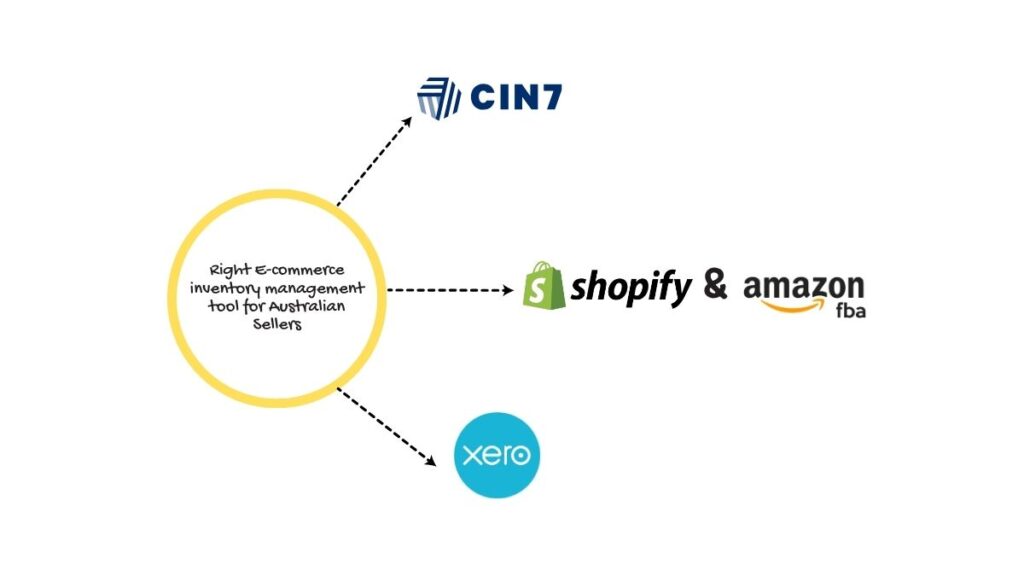
- Cin7 Core as the central inventory engine, syncing stock across warehouses, 3PLs, and every sales channel into one live pool
- Shopify inventory and Amazon AU feeding directly into that pool, so a sale on either channel updates the true available stock instantly
- Xero (or MYOB, or QuickBooks Online) pulling accurate cost of goods sold and stock valuation straight from that same connected data, instead of a separate manual step at month-end
This is where ecommerce finance and inventory operations start working as one connected system. When Shopify inventory, Amazon sell-through and your Xero ledger are all reading from the same source of truth, purchasing and reorder decisions become much easier to make with confidence. For growing sellers, having the right e-commerce accounting services alongside the inventory setup can also help keep stock values, COGS and financial reporting aligned as transaction volumes increase. We go deeper into this connection in our guide to Xero inventory management and our inventory accounting overview.
What Good Ecommerce Inventory Management Actually Looks Like
It’s worth painting the picture of the other side of this, since it’s easy to get lost in everything that can go wrong. When ecommerce inventory management is actually working, a few things become true at once:

If nobody on your team currently owns the reconciliation piece, it’s worth reading why a dedicated bookkeeper for inventory tends to pay for itself fairly quickly once stock volume grows, rather than something a spreadsheet quietly gets wrong once a year.
Final Thoughts
Ecommerce inventory management isn’t about buying more software. It’s about making your stock numbers and your financial numbers tell the same story, in real time, so you stop reacting to shortages and dead stock after the fact and start making reorder decisions off a number instead of a hunch. Get that visibility right, and a lot of the stress around stockouts and overstocking quietly disappears on its own.
When inventory, purchasing, production, and accounting all work from the same set of numbers, month-end becomes faster, reporting becomes more reliable, and decision-making becomes much simpler. VNC Australia helps manufacturers, wholesalers, and distributors implement Cin7 and Microsoft Business Central in a way that connects finance and operations without adding unnecessary complexity.
Schedule a complimentary 30-minute consultation with the VNC Australia team: Book your call.
Frequently Asked Questions
Ecommerce inventory management is the process of tracking stock levels, orders, and sales across every channel you sell on, such as Shopify, Amazon, and wholesale, so you always know what’s actually available. Done properly, it connects directly to your accounting platform so stock and financial data match.
It prevents stockouts by giving you real-time visibility into sell-through rates and stock levels, instead of reordering on a fixed schedule or gut feel. When you can see a SKU trending toward zero a week out, you reorder before the shelf actually empties.
Shopify inventory is fully within your control, so stock counts update the moment you sell. Amazon inventory, especially FBA, involves stock physically sitting in Amazon’s warehouses, which adds a lag between what you think you have and what Amazon’s system shows. Both need to sync back to one central inventory count to avoid overselling or double-counting.
Overstocking ties up cash in products that aren’t moving, which directly affects your working capital and your ability to fund new purchase orders. It also usually leads to deep discounting later to clear the stock, which erodes margin on top of the cash already trapped.
The ATO requires trading stock to be valued at the end of each income year using cost price, market selling value, or replacement value, and you can choose a different method each year for different stock items. Getting this wrong affects your taxable income, not just your internal reporting.
Xero handles the accounting side well but isn’t built as a dedicated inventory engine for multi-channel ecommerce. Most Australian sellers pair Cin7 Core for stock and channel syncing with Xero for the financial reporting, so both systems stay in agreement automatically.
Most sellers feel the pain around the $3M–$5M mark, once they’re running more than one sales channel and a spreadsheet can no longer keep pace with order volume. That’s usually the point where the cost of a stockout or a batch of dead stock outweighs the cost of fixing the system properly.