


A stock management system that is misconfigured produces wrong numbers. And wrong numbers produce wrong decisions.
Table of Contents
ToggleFor Australian manufacturers and wholesale distributors, those wrong decisions show up quietly. Margin that should be there but is not. Cash is trapped in stock that will not move. Purchase orders are placed too early or too late every single cycle.
According to the Australian Bureau of Statistics, total Australian business inventories rose 0.5% in the March quarter 2026, with wholesale trade up 1.0% and manufacturing down 1.3%. Businesses are actively trying to balance stock levels against cash flow pressure. Without a properly configured stock management system, that balancing act happens in the dark.
Your Cin7 is running. Your Xero is connected. Reports are coming through. But underneath the surface, landed costs may be missing from your inventory valuation. Stock forecasting may be based on last year’s conditions. And the accounting layer between your two platforms may have never been properly mapped.

Why Inventory Errors Do Not Fix Themselves
Inventory errors are structural, not occasional. Once a stock management system is configured with gaps, every transaction adds inaccuracy on top of inaccuracy until the numbers become unreliable at their core.
Here is how it typically plays out:

The Landed Cost Problem
Landed costs are the total cost of getting imported goods to your Australian warehouse, including freight, customs duty, marine insurance, and inspection fees. For businesses importing from Asia, these costs typically add 15% to 30% on top of the supplier invoice.
When your system records only the supplier invoice, your cost of goods sold (COGS) is understated from the moment stock enters the warehouse. COGS is the direct cost of acquiring or producing the goods you sell. When it is wrong, gross margin is wrong. When gross margin is wrong, pricing, purchasing, and channel decisions built on it are also wrong.
The Reorder Point Problem
Reorder points are the stock levels at which a new purchase order should be triggered, calculated from sales velocity and supplier lead time. When they are set once and never reviewed, they drift out of alignment with actual trading conditions.
The result? Your team keeps ordering at the wrong time, every cycle, because the system is still working from parameters set when the business was smaller, and conditions were different.
Neither of these errors self-corrects. They require someone who understands both inventory logic and accounting logic to trace them back to their source and fix the configuration at the root.
6 Signs Your Stock Management System Is the Problem
The following six signs indicate structural configuration failures, not isolated data entry mistakes.

When Cin7 and Xero are correctly integrated, inventory values stay synchronised automatically. If your bookkeeper is posting manual journals each month to reconcile the two platforms, the integration is incomplete or incorrectly mapped.
A stock management system that cannot break down the margin to the SKU level or channel level is not providing the information required to run a product business profitably. If your reporting shows total revenue and total COGS but nothing deeper, the reporting layer has not been properly configured.
A slow close is almost always a symptom of stock management failure. When inventory data does not flow automatically into Xero, reconciliation becomes manual. Manual reconciliation is slow. A well-configured system produces a clean month-end close in five to seven business days.
Regular variance between counted stock and system stock indicates that adjustments, returns, transfers, and write-offs are not being recorded in Cin7 in real time. It may also signal a landed cost or COGS allocation issue that is inflating the recorded stock value.
Landed cost tracking. Purchase order management. BOM (Bill of Materials) costing. If critical business data still lives in Excel, you have already outgrown your current system, and consequently, your exposure to errors is growing every month.
If year-end requires significant adjustments to inventory valuations or COGS, the underlying bookkeeping process has consistent structural gaps. Annual patches are not a solution. They are evidence that the root configuration has never been addressed.
What a Stock Management System Actually Needs to Do
A stock management system for an Australian manufacturer or distributor must do more than count units. It needs to connect inventory data to financial reporting in real time and give you the information to make decisions with confidence.
Here is the minimum standard a properly configured system should meet:
Freight, customs duty, insurance, and inspection fees must be allocated at the purchase order level before goods are received, so COGS in Xero reflects the full acquisition cost of every unit sold.
Whether stock is at your Sydney warehouse, a Melbourne distribution centre, or a third-party logistics (3PL) provider in Brisbane, you need one consolidated view updated as transactions happen.
Every sale processed in Cin7 must trigger the correct COGS journal in Xero without manual intervention. If this is not happening, the integration is incomplete.
Stock sold through Shopify, Amazon, or a B2B wholesale portal must reduce the same inventory in real time. Overselling because two channels are drawing from unsynchronised stock counts is a configuration failure.
Monthly inventory ageing reports by the stock-keeping unit (SKU) give you the information to act on slow movers before they need to be discounted or written off.
Reorder points must be calculated from actual sales velocity and supplier lead times and updated as those variables change.
At any point in time, the inventory asset account in Xero must match the total stock value in Cin7 without a manual reconciliation effort to make it so.
How to Configure Cin7 So Your Numbers Are Trustworthy
Most Cin7 configuration failures in Australian businesses fall into four areas. Fix all four, and your numbers become reliable.

Landed Cost Allocation
Cin7 allows landed costs to be allocated against purchase orders before stock is received. This must be configured by product type and supplier. Without it, landed costs are posted to a general expense account in Xero or disappear from inventory cost entirely.
Chart of Accounts Mapping
Every transaction type in Cin7 must map to the correct account in Xero. This includes sales, purchase orders, stock adjustments, credit notes, and transfers. When the mapping is wrong, transactions post to incorrect accounts. This is the most common reason Cin7 and Xero show different numbers.
Tax Code Alignment
Australian Goods and Services Tax (GST) rules require tax codes in Cin7 to match Xero. Products that are GST-free, input-taxed, or subject to 10% GST must be coded consistently across both platforms. Misaligned codes produce Business Activity Statement (BAS) errors. From April 2025, the ATO began moving businesses with poor lodgement histories to mandatory monthly GST reporting.
Warehouse and Location Configuration
Each physical location must be set up as a distinct warehouse in Cin7. Clear transfer procedures must also be defined. When stock moves between locations without a recorded transfer, per-location stock counts become inaccurate.
Stock Forecasting on Cin7 for Australian Businesses
Stock forecasting is the process of using historical sales data, seasonal demand patterns, and supplier lead times to predict future inventory requirements and trigger purchase orders at the right time.
For Australian businesses, this is not optional. Here is why:
- Most Australian manufacturers and distributors import from China, India, or Southeast Asia
- Lead times of 8 to 14 weeks are common
- Reordering reactively, only when the stock is already low, guarantees stockouts during that window.
- Cin7's own overstock analysis found that overstock frequently represented more than half of a seller's total inventory after peak sales periods.
Source: Cin7 Overstock Analysis Results
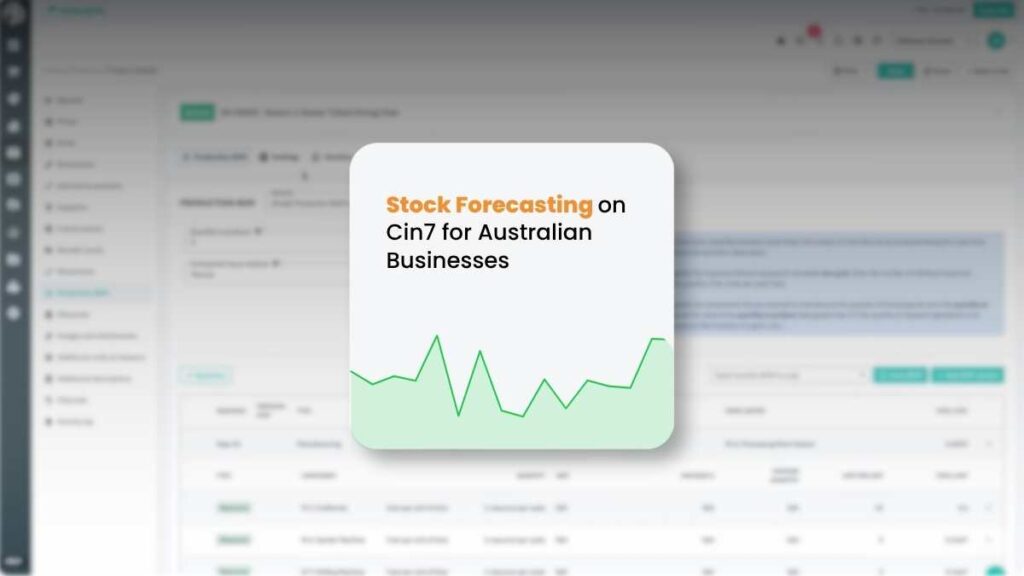
How Stock Forecasting on Cin7 Works:
Cin7’s ForesightAI module uses machine learning to analyse historical sales data and generate demand forecasts up to 24 months ahead. For each product, it calculates:
- Projected demand over the forecast window
- The optimal stock level based on that demand
- Safety stock requirements (the buffer inventory held to protect against unexpected demand or supplier delays)
- Recommended purchase order quantities and timing
Cin7’s ForesightAI module uses machine learning to analyse historical sales data and generate demand forecasts up to 24 months ahead. For each product, it calculates:
What You Need for It to Work Reliably:
- At least 6 months of clean historical sales data in Cin7
- Accurate lead time parameters set for each supplier
- Seasonal trading patterns identified and accounted for
For Australian businesses with defined peak periods like Christmas, EOFY, or school terms, dynamic stock forecasting on Cin7 reduces both the stockouts that lose sales and the overstock that locks up working capital.
Why Stock Management in Melbourne and Sydney Is More Challenging
Stock management in Melbourne and Sydney carries specific pressures that directly affect how a system must be configured.

The Import Gateway Challenge
Port of Melbourne and Port Botany in Sydney handle the bulk of Australia’s containerised imports. This creates two specific problems for stock management:
- Port congestion and variable wharf transport times make landed costs inconsistent from shipment to shipment
- Using a fixed freight rate per unit in Cin7, regardless of actual shipment cost, means landed costs are wrong on most purchase orders.
If your Cin7 setup uses a fixed rate, your inventory valuation is drifting further from reality with every delivery that comes in above or below that rate.
The Multi-Site Challenge
A typical growing business in this region might look like this:
- Primary stock held in Western Sydney
- Fulfilment hub in Melbourne's south-east
- 3PL provider in Brisbane for Queensland orders
Without real-time inter-location visibility in Cin7, businesses in this situation typically carry duplicated safety stock at every location to avoid stockouts. That inflates total inventory holding costs across the business significantly.
Stock management in Sydney and Melbourne multi-site operations also creates accounting complexity. Inter-warehouse stock transfers must generate the correct entries in Xero. When they are processed informally, inventory costs shift between locations without a corresponding accounting entry, creating variances that are difficult to trace and expensive to resolve.
The fix is a Cin7 configuration that treats each warehouse as a distinct entity with its own rules, while producing a consolidated management view for head office reporting.
Final Thoughts
Inventory errors rarely disappear on their own. As businesses grow, small discrepancies can quickly turn into costly problems that affect purchasing, cash flow, customer satisfaction, and reporting accuracy.
The key takeaway is simple: a stock management system should provide reliable, real-time visibility into inventory and support better business decisions. Whether the challenge is inventory accuracy, stock forecasting on Cin7, or maintaining alignment between inventory and accounting data, the solution often lies in improving processes, integrations, and system configuration rather than replacing software.
For Australian manufacturers and distributors, getting these fundamentals right can create a stronger foundation for sustainable growth.
Learn how VNC Australia helps Australian manufacturers and distributors optimise Cin7, improve stock forecasting, and maintain accurate inventory reporting.
Schedule a complimentary 30-minute consultation with the VNC Australia team: Book your call.
Frequently Asked Questions
A stock management system tracks inventory from purchase order through to sale. It captures the full cost of acquiring, holding, and selling each unit. For Australian manufacturers and distributors, inventory typically represents 40% to 60% of total business assets. Without accurate stock data connected to your accounting system in real time, purchasing, pricing, and cash flow decisions are built on incomplete information.
Stock forecasting on Cin7 uses the ForesightAI module. It applies machine learning to historical sales data, demand volatility, and supplier lead times. It then projects future inventory requirements and generates automated purchase order recommendations. For Australian businesses managing lead times of 8 to 14 weeks, this reduces stockouts and prevents overstock after peak trading periods. The module needs at least six months of clean sales data and accurate supplier lead times to work reliably.
Stock management in Melbourne and Sydney is more complex for two reasons. Both cities are major import gateways where port congestion affects landed cost calculations. And high commercial warehouse rates make slow-moving inventory particularly expensive to hold. Multi-site businesses face additional challenges around real-time inter-location visibility and the correct accounting treatment of stock transfers between sites.
The most common cause is an incomplete or incorrectly mapped integration. When the chart of accounts mapping in Cin7 is wrong, transactions do not generate the correct journal entries in Xero. The inventory asset account then drifts from the stock value in Cin7 over time. Fixing it requires a review of account mapping for every transaction type and correction of any COGS posting rules that are not firing correctly.
Stock forecasting uses historical sales data, seasonal patterns, and supplier lead times to predict how much stock will be needed and when to order. For Australian distributors importing from overseas, lead times of 8 to 14 weeks mean reordering reactively causes regular stockouts. Accurate stock forecasting ensures purchase orders are placed at the right time. It also prevents overstock that ties up working capital.
Australian manufacturers and distributors with a turnover above $75,000 must register for GST and lodge a Business Activity Statement either monthly or quarterly. From April 2025, the ATO moved approximately 3,500 businesses with poor lodgement histories to mandatory monthly BAS reporting. The most common GST errors involve incorrectly coded imported goods, GST-free product lines mixed with standard-rated stock, and stock write-offs not coded correctly in Cin7.